
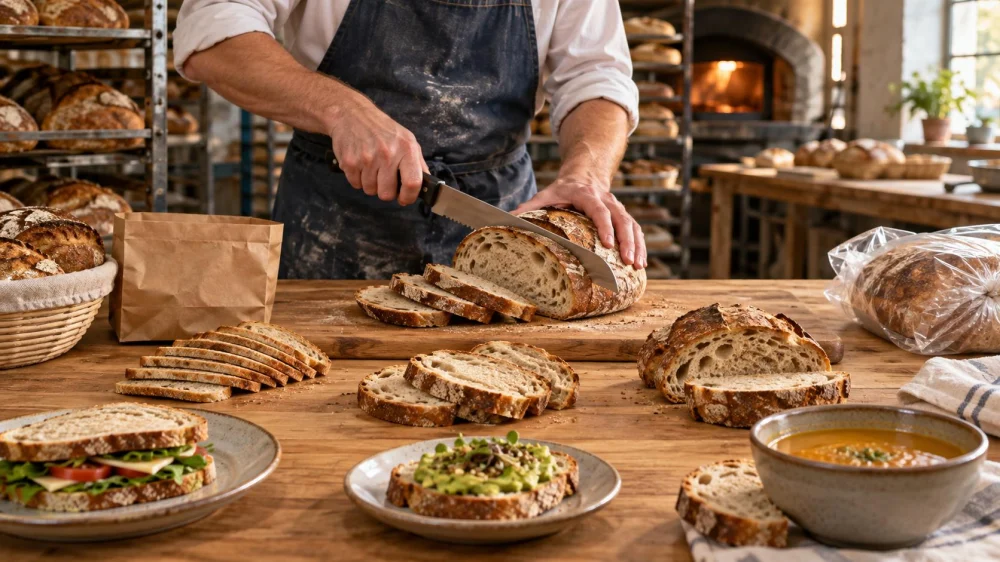
Bakery Bread Slicing: Thickness, Timing, and Storage
On this page
- Quick answer
- Match thickness to the meal
- Allow the crumb to set
- Choose machine or hand slicing
- Slice safely at home
- Slice only what helps storage
- Store the short-term portion well
- Freeze practical portions
- Limits and important notes
- Frequently asked questions
- Sources and evidence notes
- Conclusion and next steps
Quick answer
Choose bakery bread slicing by how the loaf will be used: thin, even slices for sandwiches; medium slices for toast; and thicker cuts for open-faced dishes or dipping. Let a warm loaf cool before slicing unless the baker advises otherwise. A bakery machine can make uniform cuts but may not suit crusty, seeded, filled, or very fresh loaves. Store only the near-term portion at room temperature and freeze the rest in practical packets.

Julius Sturgis Pretzel Bakery / pretzel factory lititz pa
LititzLancaster CountyPennsylvania
219 E Main St, Lititz, PA 17543, USA
Match thickness to the meal
Thin slices make a sandwich easier to bite and keep bread from overwhelming fillings. Medium slices balance crisp edges and a soft center for toast. Thick slices support wet toppings, French toast, bruschetta, or dipping but may need longer heating.
Tell bakery staff the intended use rather than asking only for thin or thick. Actual machine settings and loaf shapes vary, so a sample thickness or measurement can prevent misunderstanding.

L’Ami Bakery & Cafe / bakery in h mart
48-18 Northern Blvd, Long Island City, NY 11101, USA
Allow the crumb to set
Steam continues moving through a loaf after baking. Cutting too soon can compress a tender crumb, create gummy-looking slices, and release moisture that belongs inside. Ask how long that bread style should rest.
If the bakery sells the loaf warm, carry it in breathable packaging as directed and wait before closing it in plastic. Do not confuse warmth and aroma with readiness for machine slicing.
Choose machine or hand slicing
A bakery slicer produces fast, consistent pieces for compatible loaves. Dense crust, hard inclusions, seeds, cheese, fruit, fragile crumb, unusual shape, or warmth may make a loaf unsuitable or require a specific setting.
Hand slicing offers flexible thickness and can preserve some artisan shapes, but it takes time and a stable setup. Accept the bakery's equipment safety decision if staff decline to slice a particular loaf.
Slice safely at home
- Use a stable cutting board on a dry, non-slip surface.
- Choose a long, sharp serrated bread knife.
- Place the loaf on its most stable side.
- Keep fingertips behind the cutting path.
- Use long, gentle sawing strokes instead of crushing downward.
- Pause if the loaf, board, or hand position becomes unstable.
Slice only what helps storage
Every cut surface exposes more crumb to air, so a whole loaf can retain quality longer than the same loaf fully sliced. If convenience matters, divide it: keep a small piece whole for today and slice the remainder for freezing.
For a household with different needs, group thin sandwich slices separately from thick toast slices before wrapping. This prevents repeated thawing and searching through one large package.
Store the short-term portion well
Follow the bakery's guidance for the specific bread. Many crusty loaves do best briefly in paper or a bread box, while softer enriched breads may need a more closed package to limit drying. Climate and recipe change the tradeoff between staling and moisture.
Keep bread away from heat, sun, condensation, and contamination. Refrigeration can accelerate staling in many breads, though perishable fillings may require cold storage.
Freeze practical portions
Once fully cool, pack slices in meal-size groups using freezer-safe wrapping that limits air exposure. Separate pieces with suitable paper if they tend to stick, and label the package with the bread and date.
Freeze promptly while quality is good. Remove only what is needed and toast from frozen or thaw according to the bakery's advice. Avoid repeated thaw-and-refreeze cycles.
Limits and important notes
Storage guidance depends on ingredients, moisture, fillings, preservatives, climate, and intended shelf life. Bread containing meat, custard, soft cheese, or other perishable components may need refrigeration and stricter time control.
Check allergen information separately. A shared bakery slicer may contact wheat, sesame, nuts, dairy, egg, or other ingredients, so unsliced packaging may be the safer choice for some allergy plans.
Frequently asked questions
Can every bakery loaf be machine sliced?
No. Shape, temperature, crust, inclusions, and machine limits matter. Ask before ordering and accept staff safety guidance.
Why did my sliced loaf dry out quickly?
More exposed surface speeds moisture loss. Improve wrapping, slice later, or freeze part of the loaf sooner.
Should bread be sliced before freezing?
Slices are convenient for single servings, while a whole or half loaf may retain quality differently. Choose portions you can thaw and use without refreezing.
Sources and evidence notes
This article applies general bread structure, cutting safety, staling, packaging, freezing, and allergen cross-contact principles. The bakery's recipe-specific advice, product label, storage directions, equipment policy, and current food-safety guidance control a particular loaf.
Conclusion and next steps
Tell the bakery how you will use the bread and ask whether the loaf is cool and suitable for its slicer. At home, use a stable board and sharp serrated knife. Keep only a near-term portion accessible and freeze the rest before freshness declines.






 Nagoya Bakery4.0 (25 reviews)
 The Quantum Baker0.0 (0 reviews)
 Valerio's Tropical Bake Shop4.0 (43 reviews)
 Manny's Bakeshop & Restaurant4.0 (19 reviews)
 Nanding's Bakery4.0 (368 reviews)
 Aloha Sunrise Granola5.0 (5 reviews)
 Bakery Celebration Cake Pickup: Size, Travel, and Timing
 Bakery Bread Storage: Crust, Moisture, and Freezing Guide
 Bakery Reservation Notes: Time, Party, Access, and Contact
 Bakery Menu Portion Chec: A Heavenly Delights Bakery Reader Guide
 Bakery Service Charge Check: Bill, Tips, and Group Split
 Bakery Texture Guide: A Practical US Checklist