
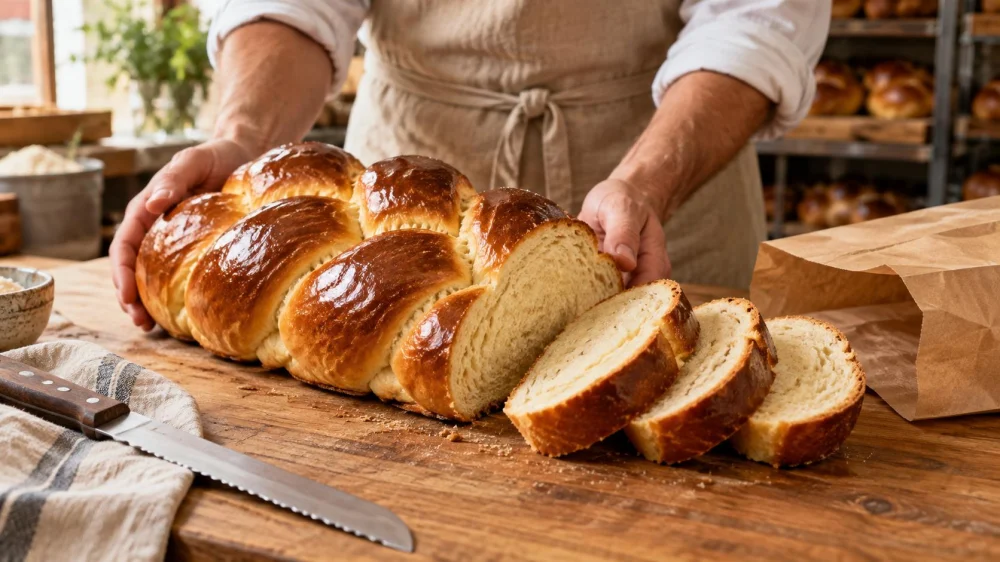
Bakery Challah Guide: Shape, Texture, Storage, and Uses
On this page
Quick answer
Choose challah by intended use, loaf size, crust color, crumb softness, sweetness, and inclusions—not braid count alone. Ask when it was baked and whether the recipe contains eggs, sesame, dairy, honey, or other ingredients relevant to your household. Keep the loaf wrapped at room temperature for short-term use, freeze well wrapped for longer storage, and slice only what you need. Day-old challah is especially useful for toast and cooked dishes.
Recipes and traditions vary by bakery and community. A round loaf, long braid, seeded top, or sweet inclusion may be seasonal or bakery-specific rather than a universal standard.

Julius Sturgis Pretzel Bakery / pretzel factory lititz pa
LititzLancaster CountyPennsylvania
219 E Main St, Lititz, PA 17543, USA
Identify the loaf you want
Tell staff when and how you plan to serve it. A pull-apart braid suits a shared table, while a uniform loaf may be easier for sandwiches or French toast. Larger loaves make a strong centerpiece but require a storage plan.
Ask about sweetness, richness, salt, seed toppings, raisins, chocolate, or other inclusions. Egg wash often creates a glossy deep-golden crust, though recipes without egg exist. Shape alone does not reveal the ingredient list.
For a religious or cultural observance, describe your exact requirement and consult the appropriate trusted authority. A bakery name or visual style does not establish certification or suitability.
L’Ami Bakery & Cafe / bakery in h mart
48-18 Northern Blvd, Long Island City, NY 11101, USA
Check freshness and texture
A well-made loaf commonly has a tender, resilient crumb and an intact crust without damp packaging. Color varies with recipe and bake. Very dark spots, compressed sides, or condensation may matter, but appearance alone cannot establish age or quality.
Ask for the bake date and best storage method. If samples are offered, compare softness, sweetness, aroma, and aftertaste rather than expecting one “correct” profile.
Inspect the package before leaving. Confirm the loaf, quantity, ingredient label when provided, and any special order details.
Slice and serve it well
- Let a warm loaf cool before sealing or slicing.
- Use a clean serrated knife and a stable cutting board.
- Cut thicker slices for French toast and thinner ones for sandwiches.
- Pull apart by hand only when that suits the occasion and group.
- Keep spreads and serving utensils separate when allergens matter.
For gentle warming, follow the bakery's instructions. Too much heat can dry the crumb or toughen exposed slices.
Store or freeze the loaf
For near-term use, keep challah tightly wrapped at room temperature in a cool, dry place. Refrigeration can make many breads stale faster, though a perishable filling or bakery instruction may require it.
For longer storage, wrap the whole loaf or useful portions tightly, add a freezer-safe outer layer, label the date, and freeze promptly. Thaw while wrapped to reduce condensation on the bread, then refresh gently if desired.
Discard bread with mold or an off odor. Do not cut away a visible mold spot and eat the rest of a soft loaf.
Ingredient and handling limits
Challah commonly contains wheat and may contain egg, sesame, dairy, honey, or other allergens, but recipes and shared equipment differ. Verify the exact product and bakery handling for food allergies.
Storage time depends on recipe, filling, packaging, temperature, and bakery guidance. A filled loaf may need different handling from a plain loaf. When label or bakery instructions conflict with general advice, follow the product-specific direction.
Sources and evidence notes
The guidance uses standard bread-quality and storage principles: minimize air exposure, avoid trapping steam, freeze promptly for longer keeping, thaw protected, and discard moldy soft bread. Cultural, certification, recipe, and allergen questions require direct product-specific verification.
Frequently asked questions
Is all challah made with eggs?
No. Many recipes use eggs, but egg-free versions exist. Check the exact bakery recipe.
Why is some challah round?
Round loaves are associated with particular traditions and seasons, but bakery shapes vary. Ask what is available and appropriate for your use.
Can I refrigerate challah?
A plain loaf often keeps better wrapped at room temperature for short use or frozen for longer storage. Follow specific instructions for fillings.
What can I do with day-old challah?
Its rich crumb works well for toast, French toast, bread pudding, croutons, or strata when handled safely.
Can I freeze a braided loaf?
Yes. Protect it from air and crushing, or freeze portions that match how you plan to serve it.
Conclusion and next steps
Choose the loaf by flavor, size, texture, ingredients, and purpose. Confirm the bake date and any observance or allergy requirement directly. Keep near-term bread tightly wrapped, freeze extra portions promptly, and slice for the dish at hand. The right challah is the one that fits both your table and your handling plan.





 Nagoya Bakery4.0 (25 reviews)
 The Quantum Baker0.0 (0 reviews)
 Valerio's Tropical Bake Shop4.0 (43 reviews)
 Manny's Bakeshop & Restaurant4.0 (19 reviews)
 Nanding's Bakery4.0 (368 reviews)
 Aloha Sunrise Granola5.0 (5 reviews)
 Bakery Service Charge Check: Bill, Tips, and Group Split
 Bakery Texture Guide: A Practical US Checklist
 Bakery Cake Quote: Size, Design, Pickup, and Allergen Notes
 Bakery Bread Crumb Check: Freshness, Cutting, and Serving
 Bakery Cupcake Pickup: Count, Box, and Safe Transport
 Bakery Whole-Grain Bread: Ingredients, Texture, and Freshness