
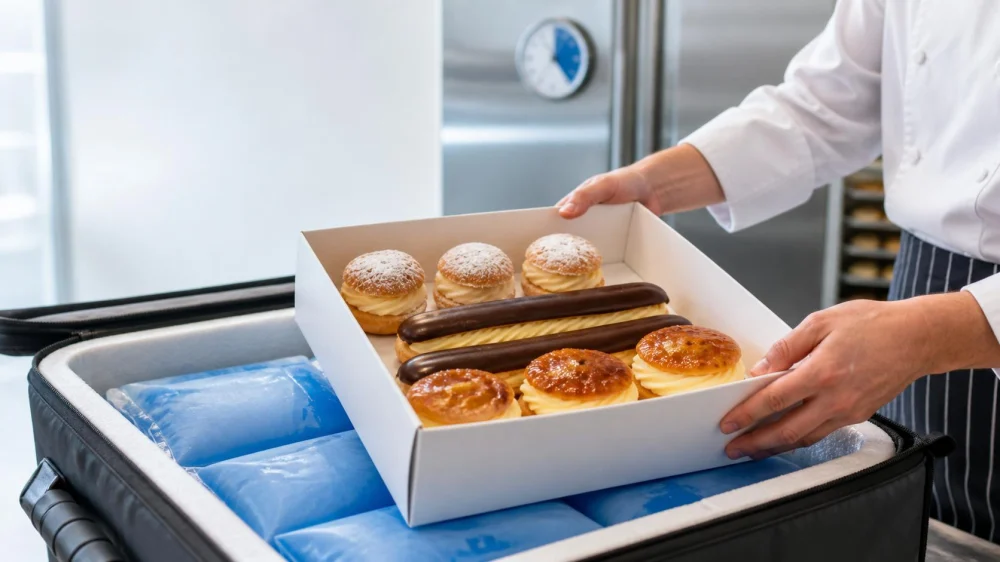
Bakery Cream-Filled Pastries: Keep Them Cold
On this page
Quick answer
Treat a bakery pastry filled with custard, pastry cream, whipped cream, cream cheese, or another perishable filling as refrigerated unless the bakery clearly says otherwise. Ask for storage directions and a use-by date, keep it at 40°F (4°C) or below, and take it straight home in an insulated cooler when the trip is long or hot. Follow the two-hour limit outside refrigeration—or one hour above 90°F—and discard it when time or temperature is uncertain.

Julius Sturgis Pretzel Bakery / pretzel factory lititz pa
LititzLancaster CountyPennsylvania
219 E Main St, Lititz, PA 17543, USA
Identify the filling
Pastries that look similar can require different storage. A plain croissant, shelf-stable fruit turnover, custard-filled doughnut, cream puff, éclair, cannoli, cheesecake bar, and whipped-cream cake do not share one universal rule.
Ask what the center or topping contains and whether the finished item requires refrigeration. Dairy and egg ingredients, water content, acidity, preparation method, and any validated shelf-stable formulation can change the answer. The bakery that made the product should know its intended storage conditions.
Do not infer safety from the pastry being displayed at room temperature. It may have just been placed out, may be held under a time-control procedure, or may use a different filling from the one you expect. Get a direct answer for the exact item.
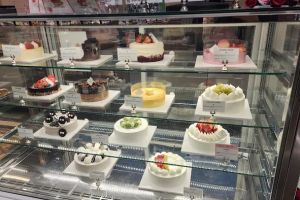
L’Ami Bakery & Cafe / bakery in h mart
48-18 Northern Blvd, Long Island City, NY 11101, USA
Ask before you leave
Before paying, ask four practical questions:
- Does this exact pastry need refrigeration?
- When was it made or removed from refrigeration?
- What is the recommended use-by time or date?
- Can it be frozen, and how should it be thawed?
Request written storage instructions on the box or receipt for a large order. If the pastry is for a person with a food allergy, separately verify ingredients and cross-contact; refrigeration does not address allergens.
If staff cannot explain how a cream-filled item should be held, choose a product with clear handling information or one that can stay refrigerated until pickup.
Transport with a cold plan
Make the bakery the last errand before home. Put refrigerated pastries in an insulated cooler with enough ice or frozen gel packs to keep them cold. Separate the box from melting ice with a clean barrier so condensation does not damage it.
Carry the cooler in the air-conditioned passenger area rather than a warm trunk. Keep it closed and out of direct sun. A bakery box, paper bag, car air vent, or shaded seat is not a substitute for reliable cold holding.
At home, refrigerate promptly at 40°F (4°C) or below. Make space before pickup so the box can sit level without being crushed. If the refrigerator is crowded, move other items rather than leaving the pastry on the counter.
Serve by the clock
FDA consumer guidance uses a two-hour rule for perishables outside refrigeration, reduced to one hour when the air temperature is above 90°F (32°C). The clock includes transport, setup, display, serving, and any later time on the counter; it does not restart each time the box is closed.
For a party, set out a small tray and replenish it from the refrigerator. If service will last longer than two hours, keep cold food at 40°F or below on a well-designed ice bed or in a refrigerated display. Use a clean utensil and protect the pastries from repeated handling.
Write down the set-out time. Do not rely on appearance, smell, or taste to decide whether a perishable filling remained safe.
Store and discard safely
Keep pastries covered in the refrigerator to limit drying and contact with other food. Follow the bakery’s stated use-by date. If no useful timeline is provided, contact the bakery rather than inventing one from a different product.
Discard a perishable cream-filled pastry that has spent more than two hours at room temperature, or more than one hour above 90°F. If several unrefrigerated periods occurred, add them together. When the duration or temperature is unknown, the safer choice is to discard.
Visible mold, sour odor, leaking filling, separation, or damaged packaging are additional reasons not to eat the product, but the absence of spoilage signs does not prove safety. Never taste a questionable filling as a test.
Handle a power outage
Keep the refrigerator door closed. FDA guidance says an unopened refrigerator generally keeps food cold for about four hours, but an appliance thermometer provides better evidence than time alone.
FoodSafety.gov’s outage chart specifically lists cream-filled pastries for disposal when they have been at 40°F (4°C) or above for more than two hours. Cheesecake and pies filled with egg or milk are also listed for disposal under those conditions.
Do not refreeze or rechill an item to reverse unsafe time above the temperature limit. Cooling slows future growth; it does not reliably undo what happened while the food was warm.
Limitations and important notes
Some commercial fillings are formulated and validated for room-temperature storage. This guide cannot classify a proprietary recipe. Follow the bakery or manufacturer’s product-specific directions when they are clear and credible.
Young children, pregnant people, adults 65 and older, and people with weakened immune systems can face higher risk from foodborne illness. A cautious cold chain is especially important when serving them.
Sources and evidence notes
The temperature and time rules below are U.S. federal consumer guidance. Local food-service rules and validated bakery procedures may add requirements.
- FDA: Are You Storing Food Safely?
- FDA: Serving Up Safe Buffets
- FoodSafety.gov: Food Safety During a Power Outage
Frequently asked questions
Does every bakery pastry need refrigeration?
No. Storage depends on the filling, topping, formulation, and bakery instructions. Ask about the exact item.
Can I leave cream puffs out for a three-hour party?
Do not leave perishable food at room temperature beyond two hours. Put out small batches and keep the rest refrigerated or properly held at 40°F or below.
Does an air-conditioned room extend the two-hour limit?
No general extension is provided. Use the two-hour limit unless the food is maintained at 40°F or below under a proper cold-holding method.
Can I tell by smelling the pastry?
No. Food can contain harmful germs without an obvious change in smell, taste, or appearance.
Can I freeze a custard pastry?
Ask the bakery. Freezing may be safe for some products but can damage texture, and it does not rescue a pastry held warm too long.
Next steps
Before pickup, confirm the filling, storage instructions, and serving time. Bring an insulated cooler when cold holding may be interrupted. Refrigerate the box promptly, mark the set-out time at service, and return small batches to the refrigerator only while they remain within the safe time window. When the history is unclear, discard the pastry rather than taste-testing it.


 Nagoya Bakery4.0 (25 reviews)
 The Quantum Baker0.0 (0 reviews)
 Valerio's Tropical Bake Shop4.0 (43 reviews)
 Manny's Bakeshop & Restaurant4.0 (19 reviews)
 Nanding's Bakery4.0 (368 reviews)
 Aloha Sunrise Granola5.0 (5 reviews)
 Bakery Reservation Notes: Time, Party, Access, and Contact
 Bakery Menu Portion Chec: A Heavenly Delights Bakery Reader Guide
 Bakery Service Charge Check: Bill, Tips, and Group Split
 Bakery Texture Guide: A Practical US Checklist
 Bakery Cake Quote: Size, Design, Pickup, and Allergen Notes
 Bakery Bread Crumb Check: Freshness, Cutting, and Serving