
Bakery Focaccia Guide: Crumb, Toppings, and Serving
On this page
Quick answer
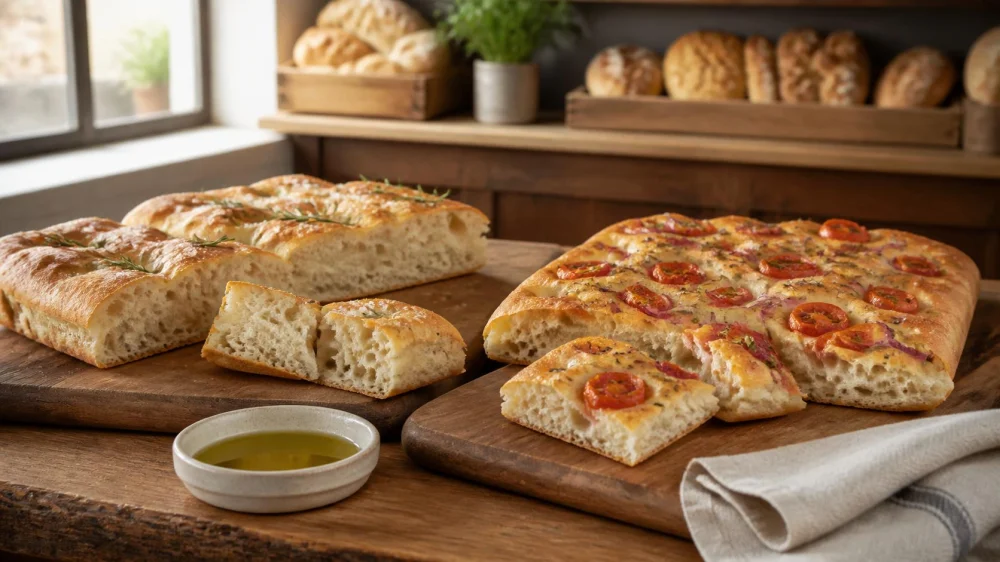
Choose bakery focaccia by looking at thickness, crumb, crust, oil level, toppings, and how you plan to serve it. A thicker, airy piece can work for sandwiches or sharing; a thinner, crisper piece suits snacking and dipping. Simple herb-and-salt versions are flexible, while vegetable, cheese, or meat toppings make the bread more meal-like and may change storage requirements.
Ask when it was baked and how the bakery recommends warming and storing that exact variety. Focaccia styles vary widely, so there is no single ideal height or texture.

Julius Sturgis Pretzel Bakery / pretzel factory lititz pa
LititzLancaster CountyPennsylvania
219 E Main St, Lititz, PA 17543, USA
Read the texture
Look for a crumb that matches your purpose. Large irregular holes suggest an open, airy interior, while a tighter crumb may hold sandwich fillings more neatly. The top can range from tender to crisp, and the bottom should feel baked rather than wet or greasy.
- For dipping: choose a sturdy piece that will not collapse immediately.
- For sandwiches: choose even thickness and a crumb that can hold fillings.
- For a bread basket: prioritize a balanced crust and tender center.
- For snacking: try a thinner, crisper cut with a focused topping.
Choose toppings with purpose
Salt, herbs, and olive oil keep the flavor adaptable. Tomatoes, onions, olives, roasted vegetables, cheese, and meats add moisture, salt, richness, and handling considerations. Heavy toppings can be satisfying but may hide the bread's fermentation and crumb.
Check whether toppings are mixed into the dough, baked on top, or added after baking. Fresh garnishes and soft cheeses can have different refrigeration needs from a plain loaf.

L’Ami Bakery & Cafe / bakery in h mart
48-18 Northern Blvd, Long Island City, NY 11101, USA
Match the piece to the meal
- Decide whether focaccia is the main item, a side, or sandwich bread.
- Estimate portions based on the rest of the meal, not the pan size alone.
- Choose one simple flavor when serving several dips or strong dishes.
- Choose a topped variety when the bread needs to stand on its own.
- Request separate wrapping for strongly aromatic or moist varieties.
For a mixed group, a plain or herb option plus one topped option gives guests a useful choice without creating too many leftovers.
Questions to ask at the counter
Ask about ingredients, allergens, shared equipment, bake time, portion size, and storage. If the focaccia will be served later, tell staff how long it must travel and whether you have access to an oven. A bakery may recommend a different cut or package for sandwiches than for immediate eating.
Do not assume visible toppings reveal every ingredient. Dough, finishing oil, sauces, and cheese blends may contain additional allergens.
Carry and serve it at home
Keep the package flat so toppings stay in place. Allow warm bread to vent according to bakery instructions so condensation does not make the crust soggy. For serving, cut with a suitable serrated knife on a stable board and warm only as directed.
Refrigerate varieties with perishable toppings when required. For longer storage, ask whether the bakery recommends freezing portions and how to reheat them without drying the crumb.
Important limitations
This is general U.S. bakery guidance. Recipes, regional styles, serving sizes, allergens, and safe storage differ. Follow the bakery's current product instructions and official food-safety guidance, especially for focaccia topped with meat, dairy, cooked vegetables, or fresh garnishes.
Evidence notes
The selection framework connects observable bread characteristics—thickness, crumb openness, crust, moisture, and toppings—to practical uses. It treats food safety separately because visual style alone cannot determine ingredients or temperature requirements.
FAQ
Is focaccia supposed to be oily?
Oil is characteristic, but the amount varies. Choose the level that fits your meal and texture preference.
Can focaccia be used for sandwiches?
Yes. An even, moderately thick piece with a stable crumb is usually easiest to fill.
Should focaccia be served warm?
It can be enjoyable warm or at room temperature. Follow the bakery's warming guidance.
Is focaccia dairy-free?
Not automatically. Dough and toppings may include dairy; check current ingredients and cross-contact information.
How much should I buy?
Ask the bakery for portion dimensions and plan around whether it is a main dish, side, or appetizer.
Next steps
Tell the bakery when and how you will serve the focaccia, then compare one simple and one topped option. Confirm ingredients and storage, keep the package flat, and cut or warm it only shortly before the meal.






 Nagoya Bakery4.0 (25 reviews)
 The Quantum Baker0.0 (0 reviews)
 Valerio's Tropical Bake Shop4.0 (43 reviews)
 Manny's Bakeshop & Restaurant4.0 (19 reviews)
 Nanding's Bakery4.0 (368 reviews)
 Aloha Sunrise Granola5.0 (5 reviews)
 Pastry Gift Box Check: Variety, Allergens, and Transport
 Sourdough Loaf Pickup: Bake Time, Slicing, and Storage
 Bakery Celebration Cake Pickup: Size, Travel, and Timing
 Bakery Bread Storage: Crust, Moisture, and Freezing Guide
 Bakery Reservation Notes: Time, Party, Access, and Contact
 Bakery Menu Portion Chec: A Heavenly Delights Bakery Reader Guide