
Bakery Terms Explained: Proofed, Laminated, and More
On this page
Quick answer
“Proofed” means yeast dough was allowed to rise; “laminated” means dough and fat were folded into layers; “enriched” means ingredients such as fat, sugar or eggs were added; and “par-baked” means baking was intentionally stopped for later finishing. These terms describe process, not guaranteed freshness, nutrition, quality or allergen safety. Ask the bakery about the exact product, ingredients, timing and handling.

Table Talk Pies Inc / table talk pies worcester ma
WorcesterWorcester CountyMassachusetts
28 Bowditch Dr, Worcester, MA 01605, USA
Why bakery terms matter
A bakery process term describes a production step, dough structure, finish or intended texture. It can help you predict whether an item is flaky, chewy, soft, crusty or rich, but different bakeries may use the same word somewhat differently.
This glossary is for customers at bakeries in the United States. It is not a labeling-law interpretation, recipe standard or guarantee about a specific business. Product cards, packaged-food labels and direct staff answers provide the relevant details.
Dough and fermentation terms
Proofed
Proofing is the rise period after dough is shaped or during a defined stage before baking. Yeast produces gas, and the dough structure retains it. Underproofed dough may be dense or split; overproofed dough may lose strength, but appearance alone cannot confirm the cause.
Bulk fermentation
This is the first main fermentation period for a mixed batch before final shaping. Bakers may fold the dough during this stage to build structure and redistribute temperature and gases.
Preferment
A preferment is a portion of flour, water and leavening prepared before the final dough. Poolish, biga and sponge are examples with different hydration and handling. The term does not automatically mean sourdough.
Sourdough
Sourdough generally uses a culture of wild yeast and lactic-acid bacteria as part of leavening and flavor development. Formulas and fermentation times vary; the word does not by itself establish nutritional or health effects.
Enriched dough
An enriched dough contains additions such as butter, oil, milk, eggs or sugar beyond a basic lean dough. Brioche and many soft rolls are enriched, but ingredients differ by bakery.
Best question: “What gives this dough its rise and richness?” Not ideal: assuming “artisan,” “slow,” or “natural” has one regulated process meaning in every display.
Pastry technique terms
Laminated
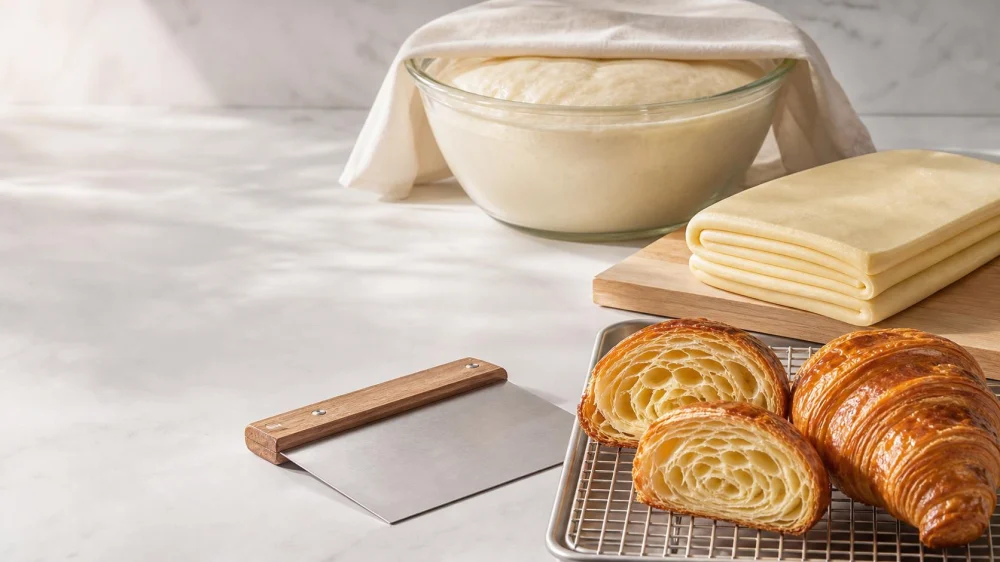
Lamination creates alternating layers of dough and fat through rolling and folding. During baking, steam separates the layers. Croissants and puff pastry are laminated, while Danish dough may also be enriched and yeast-leavened.
Shortcrust
Shortcrust uses fat to limit gluten development and create a tender, crumbly texture. It is common in tart and pie shells. “Short” refers to texture, not height or baking time.
Choux
Choux pastry is cooked on the stovetop before eggs are incorporated and the dough is baked. Steam expands it into a hollow shell for éclairs, cream puffs and similar items.
Blind baked
A crust is blind baked before or without its final filling, often to set the base and reduce sogginess. It may be partially or fully baked depending on what happens next.
Docked
Docking means making small holes or impressions so steam can escape and a crust stays flatter. A fork pattern in a tart shell is a common example.
Texture and finish terms
Crumb
Crumb is the interior structure of bread or cake: fine or open, even or irregular, soft or resilient. It is not loose crumbs on a plate.
Open crumb
An open crumb has larger, irregular air spaces. It can be desirable in some breads but inconvenient for sandwiches, and it does not prove superior fermentation.
Caramelized
Caramelization is browning associated with heated sugars. Bakers and menus sometimes use the word broadly for browned flavors; it should not be confused with every type of browning reaction.
Glazed, iced and frosted
A glaze is usually a thin coating, icing spans several pourable or spreadable finishes, and frosting is often thicker. Regional and bakery usage varies, so ask about ingredients and texture.
Tempered chocolate
Tempering controls cocoa-butter crystals to create shine, snap and stability. It describes technique, not cacao percentage or absence of allergens.
Production and display terms
Par-baked
A par-baked item is partially baked and finished later. This can support fresh final baking at another location. It is not the same as raw dough and does not automatically mean lower quality.
Baked today
This usually describes the date of final baking, but ingredients, dough or a frozen par-baked component may have been prepared earlier. Ask what matters to you rather than treating the phrase as a full production history.
Made in-house
This may mean mixed, shaped, filled or finished on site, depending on the business. A clear question—“Which stages happen here?”—gets a more useful answer.
Seasonal
A seasonal item may be available for a limited period or use ingredients associated with a season. It does not necessarily mean every ingredient is locally grown or currently harvested.
Day-old
Day-old usually identifies items offered after their primary sale day. Storage and suitability vary by product, so ask how it was held and how the bakery recommends using it.
What these words do not prove
- “Sourdough” does not guarantee gluten-free status or suitability for a medical condition.
- “Vegan” does not mean free from wheat, nuts, soy or shared-equipment cross-contact.
- “Artisan” does not give a universal freshness date or production method.
- “Natural” does not confirm ingredient sourcing, nutrition or allergen controls.
- “Fresh” does not replace a specific baked-on, packed-on or use-by statement.
- “Local” may describe the business, production or an ingredient; ask which one.
For a serious allergy, ingredients and cross-contact procedures matter more than descriptive menu language. Ask trained staff and decide based on the bakery’s documented information.
Questions that get useful answers
- “What is the main leavening method in this loaf?”
- “Was this item baked here today, or finished here from a prepared product?”
- “Which filling is inside, and does it require refrigeration?”
- “How would you describe the crumb and crust?”
- “What is the recommended serving or reheating method?”
- “Can I see current ingredient and allergen information?”
Ask during a quieter moment when possible, but do not let a busy line pressure you into accepting uncertain allergy information. Choose a different item or bakery if staff cannot answer a safety-critical question.
Sources and evidence notes
Definitions here reflect common professional baking usage. Bakeries, culinary traditions and product standards differ, so these are working explanations rather than legal definitions for every label. Recipe documentation, packaging and direct bakery information take priority for a specific item.
Frequently asked questions
Is laminated dough the same as puff pastry?
Puff pastry is laminated, but laminated dough also includes croissant and some Danish doughs, which can contain yeast and enriched ingredients.
Does sourdough always taste sour?
No. Flavor depends on culture, flour, time, temperature and formula. Some sourdough breads are mild.
Is par-baked bread stale?
No. It is intentionally partially baked for later finishing. Quality depends on the full process and handling.
What does “crumb” mean in cake?
It describes the interior texture and structure—fine, coarse, tender, moist or resilient—not just pieces that fall off.
Does “made in-house” mean every ingredient was made there?
Not necessarily. Ask which steps occur on site and whether components arrive prepared.
Conclusion and next steps
Use bakery terms to predict process and texture, then ask product-specific questions. “Proofed,” “laminated,” “enriched” and “par-baked” explain how an item was made, not whether it meets every freshness, nutrition or allergy need. A precise question about ingredients, timing and storage is more useful than relying on a broad marketing word.


 Sweet Don Don's Fudge and Confections0.0 (0 reviews)
 Fresh Baguette4.0 (196 reviews)
 Cham Bakery4.0 (75 reviews)
 Kim's Orient Express4.0 (260 reviews)
 Cupcakes and Curiosities4.0 (88 reviews)
 NY Bagel Fullerton4.0 (122 reviews)
 The Best Bakery Breads to Serve with Stew or Chili
 How to Make Bakery-Style Banana Bread with a Perfectly Moist Texture
 How to Make Bakery-Style Croissants with Puff Pastry
 How to Create Beautiful Cake Layers for Any Celebration
 How to Make Bakery-Style Peach Cobbler with a Crispy Topping
 Top Bakery Trends to Watch in 2025 | Innovative Baking Insights