
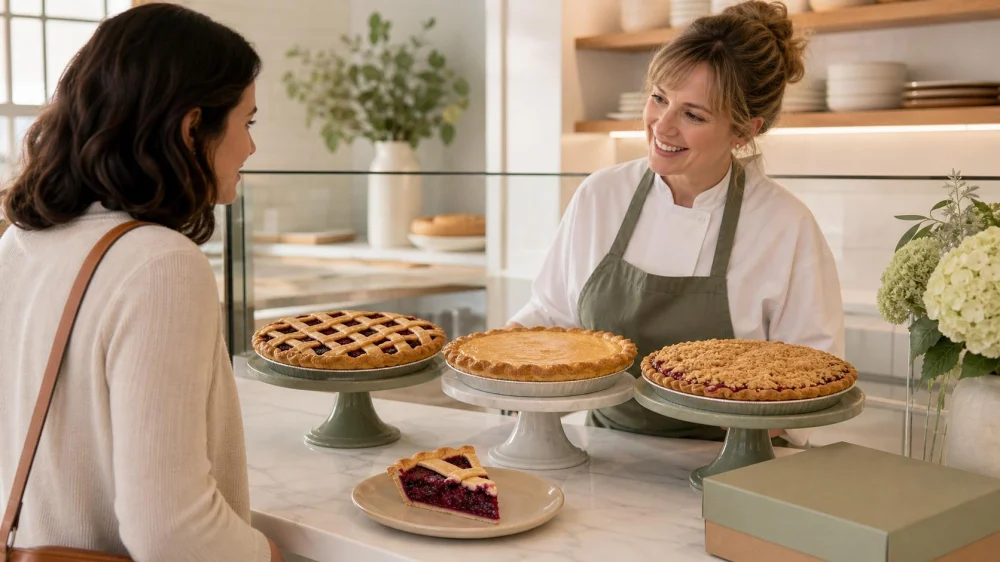
Choose a Bakery Pie by Filling, Crust, and Serving Plan
Quick answer: Choose the filling family first—fruit, custard, cream, nut, chocolate, or savory—then decide how crisp, flaky, crumbly, or sturdy the crust should be. Confirm serving temperature, refrigeration, slice count, allergens, transport time, and whether the pie needs reheating. The best choice is one that reaches the table in the texture the baker intended.
Pie names tell only part of the story. Two apple pies can differ in sweetness, spice, fruit texture, thickener, crust style, depth, and how cleanly they slice. Ask the bakery questions that connect the recipe to your event.
1. Start With the Filling Family
Fruit pies emphasize cooked or fresh fruit and may be served warm or at room temperature. Custard pies set eggs and dairy or alternatives in the crust. Cream or chilled pies depend on a refrigerated filling. Nut pies are dense and sweet, while chocolate pies can range from baked custard to chilled mousse.
Tell the bakery whether the pie is dessert after a rich meal, part of a mixed table, or the main celebration item. A bright fruit filling may balance a heavy menu; a dense nut or chocolate slice may work better in smaller portions.

Julius Sturgis Pretzel Bakery / pretzel factory lititz pa
LititzLancaster CountyPennsylvania
219 E Main St, Lititz, PA 17543, USA
2. Clarify Fruit Texture and Sweetness
Ask whether fruit pieces stay distinct or cook into a jammy filling, whether the flavor leans tart or sweet, and which spices or citrus are prominent. Seasonal fruit can change in moisture and acidity, so the bakery may adjust the recipe.
Ask how the pie slices: very juicy fillings may be delicious but less tidy on a buffet. If clean slices matter, confirm the recommended cooling time and whether the pie should be cut chilled, room-temperature, or warm.

L’Ami Bakery & Cafe / bakery in h mart
48-18 Northern Blvd, Long Island City, NY 11101, USA
3. Understand Custard and Cream Pies
Custard, cream, mousse, cheesecake-style, and meringue pies often require refrigeration and careful transport. Ask which category the bakery uses, what the texture is, and how long it may be out for serving under current food-safety guidance.
Do not assume a baked top makes a dairy- or egg-rich pie shelf-stable. Confirm pickup temperature, refrigerator space, and serving instructions before ordering for a picnic or long drive.
4. Match the Crust to the Filling
A flaky pastry crust gives crisp layers but can soften under a wet filling over time. A short or cookie-style crust is tender and crumbly. Graham-style, chocolate crumb, nut, or gluten-free crusts bring their own flavor and structural limits.
Ask whether the pie has a bottom crust only, double crust, crumb shell, or blind-baked shell filled later. If the pie must travel or sit on a buffet, a slightly sturdier crust and full cooling may be more practical than the most delicate option.
5. Choose a Top Crust or Topping
A full top crust traps steam and creates a substantial pastry layer. Lattice shows the filling and lets more moisture escape. Crumb topping adds sweetness and crunch; meringue and whipped toppings are lighter but more sensitive to heat and movement.
Ask whether sauces, whipped cream, ice cream, or garnishes are included or sold separately. Pack cold accompaniments independently so they do not soften the crust or slide during transport.
6. Confirm Size and Slice Count
Ask for diameter, depth, and the bakery’s suggested slice size. A deep-dish pie may serve differently from a shallow pie of the same diameter. Tell the bakery whether other desserts are available and whether guests will self-serve.
For a mixed crowd, two smaller pies can offer variety and simpler dietary separation. Request a cutting guide when uniform portions matter, and bring a sharp knife and pie server suitable for the crust.
7. Ask About Ingredients and Cross-Contact
Confirm the filling, crust fat, thickeners, egg wash, topping, garnish, and any shared equipment. Common concerns can include wheat, milk, eggs, nuts, peanuts, soy, sesame, and other recipe-specific ingredients. “Fruit pie” does not mean dairy-free or vegan; “gluten-free crust” does not prove an allergen-free kitchen.
For an allergy, state it clearly and ask what the bakery can verify about ingredients, shared mixers, benches, pans, ovens, display cases, and utensils. If cross-contact controls cannot meet the need, choose a sealed verified option or do not serve that item to the affected person.
8. Plan a Level Trip Home
Use a rigid pie box on a flat vehicle floor or stable cargo surface, not a sloped seat or lap. Add a nonslip mat under the closed box and keep heavy groceries separate. Chilled pies should travel in an insulated cooler with cold packs arranged so they do not crush the box.
Drive directly and avoid sun or a hot parked vehicle. Carry the box from the bottom with two hands. At destination, move the pie to the temperature the bakery specified before unpacking decorations or cutting.
9. Follow Serving and Reheating Directions
Ask whether the pie is best cold, cool room temperature, or warm. For reheating, get the oven temperature, time range, whether to remove packaging, and how to shield the crust. A whole fruit pie and a single slice need different timing.
Do not microwave a foil pan or assume every topping can be heated. Whipped cream, meringue, custard, and some decorative elements may need separate handling. Let a reheated fruit pie rest as directed so hot filling thickens and does not burn the server.
10. Store Leftovers for the Specific Filling
Follow the bakery’s written instructions. Refrigerate pies that require it promptly in a covered container, keeping strong odors and raw foods away. Do not use a generic “pie lasts on the counter” rule across egg-, dairy-, cream-, fruit-, and nut-based fillings.
Label the date and dietary status. Freeze only when the bakery says the filling and topping handle freezing well; thaw as directed. Discard leftovers with an unknown time-temperature history rather than tasting to decide.
Pie-order checklist: filling family; sweetness and texture; crust and top; diameter and depth; slice count; ingredients and cross-contact; pickup temperature; transport; serving and reheating instructions; and filling-specific storage.
This article provides general bakery-planning information. Follow the bakery’s recipe-specific instructions, product labels, and current food-safety guidance.




 Nagoya Bakery4.0 (25 reviews)
 The Quantum Baker0.0 (0 reviews)
 Valerio's Tropical Bake Shop4.0 (43 reviews)
 Manny's Bakeshop & Restaurant4.0 (19 reviews)
 Nanding's Bakery4.0 (368 reviews)
 Aloha Sunrise Granola5.0 (5 reviews)
 Bakery Service Charge Check: Bill, Tips, and Group Split
 Bakery Texture Guide: A Practical US Checklist
 Bakery Cake Quote: Size, Design, Pickup, and Allergen Notes
 Bakery Bread Crumb Check: Freshness, Cutting, and Serving
 Bakery Cupcake Pickup: Count, Box, and Safe Transport
 Bakery Whole-Grain Bread: Ingredients, Texture, and Freshness