
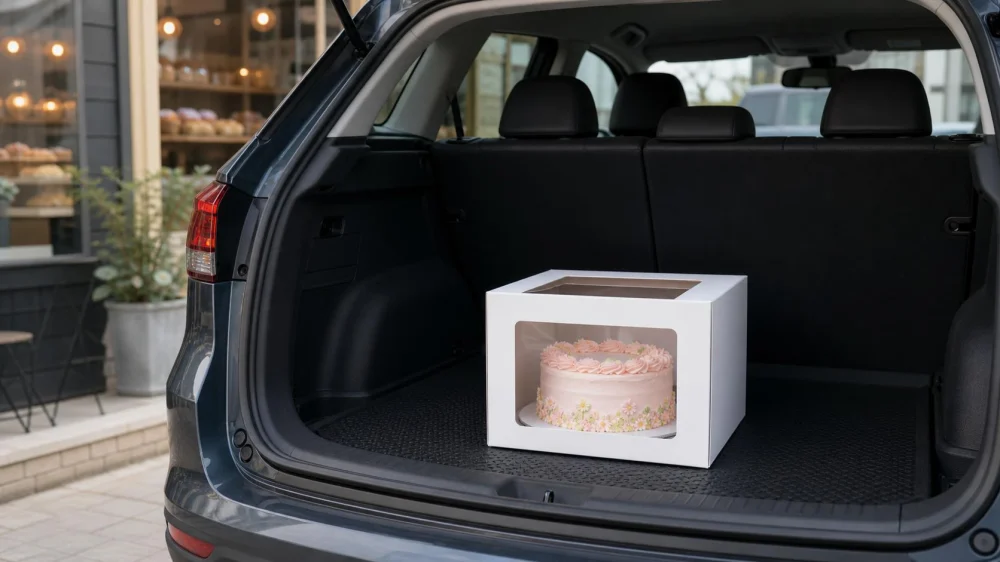
How to Carry a Bakery Cake Home Without Damaging It
On this page
Quick answer
Transport a bakery cake on its rigid base inside the closed box, kept level on a clean non-slip surface in a cool vehicle. Clear the route and refrigerator before pickup, support the box from underneath, avoid seats and laps, drive gently, and go directly to the destination. Follow the bakery's instructions for refrigeration, stacking, supports, and assembly because tall or delicate cakes may require professional delivery.

Mazzacottos / mozzicato wallingford
HartfordCapitol Planning RegionConnecticut
Hartford, CT 06103, USA
Ask the bakery before pickup
Cake structure varies. Buttercream, whipped topping, cream cheese frosting, mousse, custard, fresh fruit, fondant, ganache, and frozen components respond differently to heat, vibration, and storage. Size, height, tiers, decorations, and internal supports also change what is safe to carry.
Confirm these details when ordering or before pickup:
- Box dimensions and total cake size
- Whether the cake must stay refrigerated or frozen
- The recommended maximum transport conditions and direct-travel plan
- Whether tiers are fully assembled or packed separately
- Where internal supports, toppers, or dowels are located
- Which decorations should be attached at the destination
- Whether the bakery recommends or requires delivery
- Ingredient and cross-contact information needed by guests
Ask staff to show which side is front and where your hands can safely support the box. Keep written storage and serving instructions. Do not open the package in the parking lot merely to inspect decoration unless staff directs you.
Bagelsaurus / bagel saurus
CambridgeMiddlesex CountyMassachusetts
1796 Massachusetts Ave, Cambridge, MA 02140, USA
Prepare a cool, flat transport space
- Measure the opening and floor. Make sure the box can pass through the door or hatch without tilting.
- Clear the area. Remove groceries, sports gear, tools, pet equipment, and any object that can slide into the cake.
- Choose a low, level surface. A flat cargo floor or footwell may be better than a sloped seat. Confirm it is clean and large enough.
- Add grip. Use a clean non-slip shelf liner or rubberized mat under the box. Do not use a thick cushion that can wobble.
- Cool the vehicle. Bring the cabin to an appropriate temperature before the cake is loaded, following bakery advice.
- Plan separation. Keep pets, children, direct sunlight, loose objects, and strong odors away from the cake area.
- Set navigation first. Enter the destination and route before pickup so the driver does not handle a phone while moving.
Do not place a cake in a car trunk that becomes hot or lacks the conditions recommended by the bakery. Air conditioning helps only when cool air reaches the cake; do not block vents or point forceful airflow directly at fragile decorations.
Lift and carry the box correctly
Wash and dry your hands, remove dangling bags, and clear the path before accepting the cake. Support the box with both hands under the rigid base. Keep it horizontal and close to your center of balance.
- Do not lift by the lid, side flaps, window, string, or decorative handle unless the bakery confirms it is load-bearing.
- Do not squeeze the sides; they can touch frosting and transfer pressure to the cake board.
- Use a second person to open doors and guide the route, not to hold one side of the box at a different height.
- Take ramps or smooth paths when available and watch thresholds, curbs, wet pavement, stairs, and low doorframes.
- Set the cake down only on a clean, stable, level surface.
A large box can block your view. If you cannot see your feet or safely manage the door, stop and ask bakery staff or another adult for help. Do not carry a cake while also handling keys, a phone, drinks, or other bags.
Drive for the cake, not the clock
The driver should not hold or monitor the cake. Secure the box against sliding without compressing it, close doors gently, and ask a passenger to watch from a safe belted position only if that does not create a distraction.
Accelerate, brake, and turn smoothly. Leave extra following distance, slow before bumps and railroad crossings, and avoid abrupt lane changes. Use the smoothest reasonable route, even if it is slightly longer, but do not compromise food-storage limits.
Go directly to the destination. Do not leave the cake in a parked vehicle while running errands. If traffic, a breakdown, or another delay threatens the bakery's storage guidance, call the bakery from a safe stopped location for advice.
Road safety takes priority over cake appearance. Never stop unsafely, speed, block traffic, or reach into the cargo area while driving to correct a shifting box.
Move the cake into storage
- Park on the most level safe surface available.
- Have another adult open the route from vehicle to storage.
- Support the box from underneath and keep it level.
- Place it immediately in the bakery-recommended refrigerator, freezer, or cool room.
- Keep the box on a flat shelf with nothing stacked on top.
- Photograph damage before attempting a repair and contact the bakery for guidance.
- Add toppers or assemble components only according to instructions.
Do not push a box into a shelf that is too small, remove the structural base, or rest it partly over a wire edge. If storage does not fit, keep the cake in the approved conditions while contacting the bakery; do not improvise with an unsafe temperature.
Adjust for weather and cake design
Hot and humid weather can soften frosting and increase condensation. Cold weather can make some decorations brittle, and rain can weaken cardboard packaging. Use a covered loading route and keep the box dry without wrapping it so tightly that pressure reaches the cake.
Tall, narrow, sculpted, multi-tier, or heavily topped cakes have a higher center of gravity and more opportunities for parts to move. They may need separate boxes, chilled transport, custom supports, onsite assembly, or professional delivery. When the bakery says a design is delivery-only, that is a decision boundary—not an upsell to bypass.
For long distances, ask the bakery whether the design is suitable at all. A travel-friendly cake may use lower tiers, simpler decoration, separate toppers, or components assembled at the destination.
Limitations, safety, and evidence notes
This guidance reflects common bakery packaging, cold-storage, and fragile-load practice. It cannot determine the safe temperature or transport duration for a specific recipe. The bakery's current product instructions, packaging design, and applicable food-safety guidance take priority.
A closed box hides movement, and visual appearance cannot confirm food safety. If the cake warms beyond guidance, the box falls, packaging opens, foreign material contacts the food, or storage conditions are uncertain, ask the bakery before serving.
Drivers must follow traffic laws and secure cargo without interfering with seats, pedals, airbags, visibility, or emergency exits. Never place a cake where it can become a projectile or prevent safe vehicle operation.
Frequently asked questions
Can I put a cake on a car seat?
Most seats slope and allow a box to slide or tilt. A clean, flat, low surface with a non-slip mat is usually more stable, provided it does not interfere with vehicle safety and the bakery approves the temperature conditions.
Should someone hold the cake on their lap?
No. A lap moves, may be angled, and cannot secure the cake during sudden braking. The passenger also needs to remain correctly belted without a large box affecting restraint performance.
Can I open the box to check the cake during the trip?
Opening exposes it to warm air, dust, contact, and accidental damage. Check only after stopping safely and only when bakery guidance makes it necessary.
What if the cake slides inside the box?
Stop at a safe location without sudden movement. Keep the box level and contact the bakery before opening or trying to reposition decoration. Some damage can be corrected more easily by a professional.
When is bakery delivery the better choice?
Choose delivery for very tall, tiered, sculpted, temperature-sensitive, high-value, or onsite-assembly designs, or whenever the bakery says personal transport is unsuitable. Delivery is also sensible when your vehicle lacks a flat cooled space.
Conclusion and next steps
Measure the box and storage, prepare a cool flat vehicle area, support the cake from below, drive smoothly, and move it directly into approved storage. Let the bakery's recipe-specific instructions determine the limits. When the design is too tall, delicate, or temperature-sensitive for your setup, choose professional delivery rather than gambling with the cake.





 Meijer Bakery3.0 (1 reviews)
 IFT Bakery3.0 (29 reviews)
 Costco Bakery5.0 (3 reviews)
 Psycho Donuts4.0 (753 reviews)
 La Maison5.0 (8 reviews)
 Knapp Street Bagel Cafe3.0 (194 reviews)
 The Best Bakery Breads for Making Delicious French Toast
 How to Make the Best Homemade Banana Pudding
 Exploring Artisan Chocolate and the Best Bakeries to Find It
 The Secret to Making a Perfectly Soft and Fluffy Cake | Baking Tips
 Best Baking Hacks for Busy Mornings: Quick Tips for Delicious Breakfasts
 Mastering the Basics of Breadmaking: Your First Loaf Made Simple