
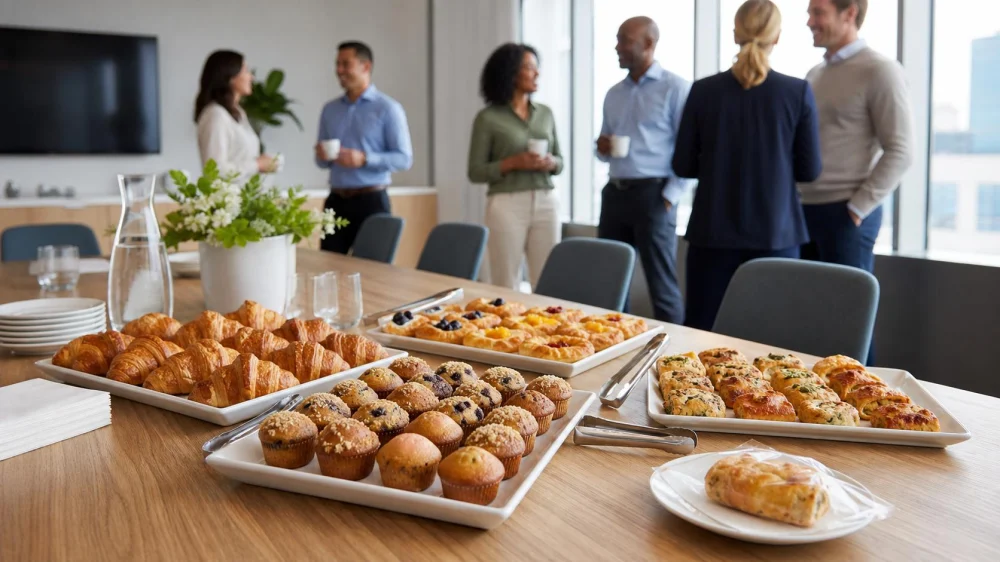
How to Plan a Bakery Order for a Workplace Meeting
On this page
Quick answer
Plan a workplace bakery order from the meeting format, confirmed headcount, time of day, budget, dietary needs, serving space, and cleanup plan. Ask the bakery for actual item sizes and ingredient information, choose mostly easy-to-handle pieces, keep special-diet items separate, schedule arrival before guests gather, and assign one person to receive, check, label, serve, store, or discard food appropriately.

Julius Sturgis Pretzel Bakery / pretzel factory lititz pa
LititzLancaster CountyPennsylvania
219 E Main St, Lititz, PA 17543, USA
Define the meeting before choosing food
A breakfast briefing, training session, client presentation, celebration, interview day, and all-hands meeting need different food. Begin with the event rather than a favorite pastry.
- Purpose: Is food the main hospitality feature or a small accompaniment?
- Timing: Will guests arrive hungry, eat during discussion, or wait for a scheduled break?
- Duration: Does food need to hold for minutes or remain suitable through a long session?
- Room: Are there tables, plates, refrigeration, sinks, waste bins, and a separate serving area?
- Format: Will people be seated, standing, moving between rooms, or joining remotely?
- Professional context: Could crumbs, strong odors, sticky fillings, or utensils distract from documents and equipment?
For a working meeting, compact individual items are often easier than products that require slicing, assembly, or two hands. A celebration may justify a centerpiece, but it also requires a cutting plan and time.
L’Ami Bakery & Cafe / bakery in h mart
48-18 Northern Blvd, Long Island City, NY 11101, USA
Build a realistic headcount
- Use accepted invitations or a current roster rather than the maximum room capacity.
- Include presenters, support staff, reception, drivers, and other people expected to attend.
- Confirm whether remote attendees or staggered shifts need separate arrangements.
- Ask whether attendees expect a full meal or only a light snack.
- Set a final response deadline before the bakery's change or cancellation deadline.
- Keep a small, reasoned buffer based on uncertainty; do not automatically double the order.
Item count is not the same as serving count. A large muffin, mini scone, croissant, cookie, and sliced loaf provide different portions. Ask the bakery how its specific products are normally portioned and whether items can be cut without losing quality.
Budget using the full order: food, delivery, service fees, tax, packaging, beverages, utensils, and an appropriate tip under workplace policy. Do not promise a price until the bakery confirms the quote.
Choose a practical assortment
Build variety through a few clear categories instead of one of everything. A useful assortment may include:
- A familiar, less-messy option
- A fruit- or spice-forward option
- A savory bakery item when the meeting overlaps a meal
- A smaller or lower-sweetness choice
- Verified options for identified dietary needs
Match texture to the room. Flaky laminated pastries can scatter crumbs; powdered sugar marks dark clothing; sticky glazes transfer to keyboards; tall frosting needs careful handling. These may be enjoyable during a social break but less suitable beside contracts or shared equipment.
Do not choose solely by visual variety. Several products may share the same filling, allergens, or sweetness level. Ask the bakery to describe item size, flavor profile, serving temperature, packaging, and how long quality holds after delivery.
Handle dietary needs and allergens
Collect dietary information privately and only to the level needed for ordering. Use neutral questions and do not ask attendees to disclose diagnoses publicly. Distinguish preference, religious or cultural practice, intolerance, and medically serious allergy because the bakery's ability to manage each may differ.
Ask the bakery:
- Which ingredients it can verify for each item
- Whether products share mixers, ovens, fryers, trays, display cases, utensils, or preparation surfaces
- How special items will be wrapped, identified, and separated
- Whether ingredient documentation is available with the order
- What it cannot guarantee
Keep special-diet items in their original separate packaging until the intended person receives them. Do not place them on a shared tray with common tongs or move labels between products. If the bakery cannot meet a serious need, arrange an appropriate alternative rather than offering reassurance it did not provide.
Plan ordering, pickup, and delivery
- Order early enough. Ask about lead time, production capacity, minimums, substitutions, changes, and cancellation.
- Write the details. Include date, local time, address, building entrance, floor, room, contact number, parking or loading instructions, and security process.
- Set an arrival window. Allow time to inspect and arrange food without leaving perishable items too early.
- Assign one receiver. That person should know the order, have payment authorization, and be reachable.
- Check before accepting. Confirm quantities, special packaging, serving items, visible damage, and storage directions.
- Keep records. Save the final invoice, ingredient information, delivery confirmation, and bakery contact.
For pickup, clear a flat vehicle space and go directly to the workplace. Keep boxes level and follow product-specific temperature instructions. Do not leave food unattended in a vehicle, lobby, or unsecured room.
Set up service and manage leftovers
Place food on a stable surface away from computers, cables, confidential papers, exits, and heavy traffic. Provide appropriate tongs or serving utensils, napkins, plates, water, and clearly positioned waste and recycling bins.
Identify products using bakery-provided information without making new allergen claims. Keep packaging or an ingredient sheet accessible. Do not let guests swap utensils between trays, and do not top up a nearly empty tray by pouring new food over older food.
Assign cleanup before the meeting starts. Follow the bakery's guidance and workplace food policy for holding time, refrigeration, sharing, and disposal. Do not leave leftovers in a break room without a date, responsible owner, and storage plan. Food that has been handled widely or held under uncertain conditions may need disposal rather than redistribution.
Record what was popular, what remained, timing issues, and any dietary gap. That creates a better estimate for the next meeting without inventing a universal per-person formula.
Limitations and evidence notes
This guidance reflects common catering, bakery-order, workplace hospitality, and food-handling practice. Bakeries and workplaces across the United States differ in item sizes, allergen controls, delivery terms, prices, food policies, refrigeration, and waste systems. Current vendor documentation and workplace rules take priority.
No assortment can guarantee equal preferences or eliminate allergen risk. A “gluten-free,” “vegan,” or “nut-free” product name does not by itself describe cross-contact controls. For medically significant needs, rely on what the bakery can document and the individual's own risk-management guidance.
Frequently asked questions
How many pastries should I order per person?
There is no reliable universal number because item size, meeting time, menu role, and attendee needs vary. Give the bakery the confirmed headcount and event context, ask how its items are portioned, and document the result for future orders.
Are mini pastries better for meetings?
They can support sampling and smaller portions, but may require more packaging and handling. Compare actual size, mess, price, serving method, and the number of varieties rather than assuming mini is always better.
Should I order only sweet items?
For a short coffee break, that may fit. For morning or meal-adjacent meetings, a savory and less-sweet option can broaden the assortment. Confirm storage and serving needs.
How should special-diet items be displayed?
Keep them separately wrapped and identified using the bakery's verified information. Use dedicated utensils and avoid placing them on a shared tray. Ask the intended attendees whether the arrangement meets their needs.
Is delivery better than pickup?
Delivery helps with large, delicate, time-sensitive, or multi-box orders and difficult parking. Pickup may work for a smaller order when a responsible person has a clean flat vehicle space and enough setup time. Compare risk and total logistics, not only the fee.
Conclusion and next steps
Define the meeting, confirm the people, choose a small purposeful assortment, and ask the bakery what it can verify. Put one person in charge of the final order, delivery, setup, and cleanup. A documented plan for portions, dietary needs, timing, and leftovers creates a smoother meeting and a much better starting point for the next one.





 Nagoya Bakery4.0 (25 reviews)
 The Quantum Baker0.0 (0 reviews)
 Valerio's Tropical Bake Shop4.0 (43 reviews)
 Manny's Bakeshop & Restaurant4.0 (19 reviews)
 Nanding's Bakery4.0 (368 reviews)
 Aloha Sunrise Granola5.0 (5 reviews)
 Bakery Celebration Cake Pickup: Size, Travel, and Timing
 Bakery Bread Storage: Crust, Moisture, and Freezing Guide
 Bakery Reservation Notes: Time, Party, Access, and Contact
 Bakery Menu Portion Chec: A Heavenly Delights Bakery Reader Guide
 Bakery Service Charge Check: Bill, Tips, and Group Split
 Bakery Texture Guide: A Practical US Checklist